Comparing the 2026 Subaru Trailseeker to the Competition
The all-new 2026 Subaru Trailseeker offers the most room among the expanded EV lineup. With more dual-motor performance and a taller ground clearance, it offers the superb traction of the standard Symmetrical All-Wheel Drive system. The EV SUV offers practicality that fits your lifestyle and the space to do anything anywhere. Along with the technology and safety that will keep you loving your Trailseeker for the long run, it is also available in four trim levels—each designed for how you express yourself electrically.
How well does the 2026 Subaru Trailseeker compare against the competition?
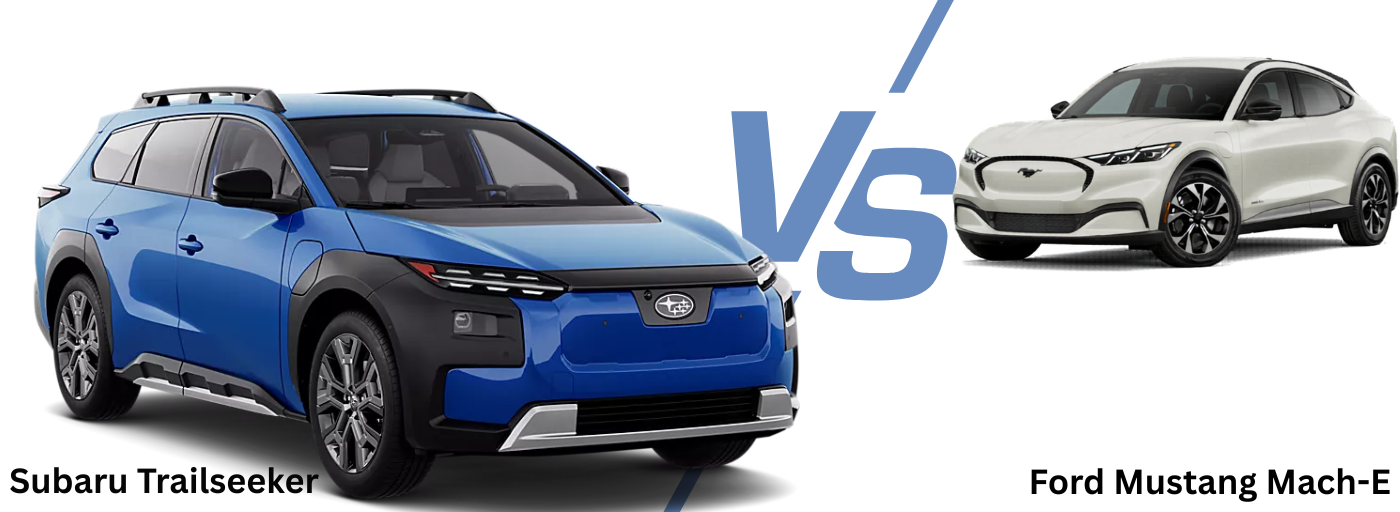
Trailseeker vs. Ford Mustang Mach-E
Ford applied its iconic name to a four-door electric SUV while adding elements of the pony car’s design. Yet it is practical and offers advanced features not found in its muscle-car namesake. It comes in single-motor rear-wheel-drive and dual-motor all-wheel-drive models.
- The Trailseeker offers more cargo space than the Mustang Mach-E with the rear seats down. You can load the Subaru with up to 74.0 cubic feet of everything. The Ford offers up to 59.7 cubic feet of cargo space.
- Subaru has always offered higher ground clearance across all its models with Symmetrical All-Wheel Drive to allow them to travel farther from the highway. The Trailseeker stands 8.5 inches above the ground, while the Mustang Mach-E with all-wheel drive has only 5.7 inches of ground clearance.
- The standard Symmetrical All-Wheel Drive system on the Trailseeker is a full-time system. It also includes X-Mode with Downhill Assist Control. The Mustang Mach-E’s all-wheel-drive system is not only an option but an on-demand system.
- When equipped with roof rails, your SUV can be loaded with accessories to enhance the practicality of your adventure. That is why all Trailseeker models have standard roof rails. The Mustang Mach-E is not equipped with them.
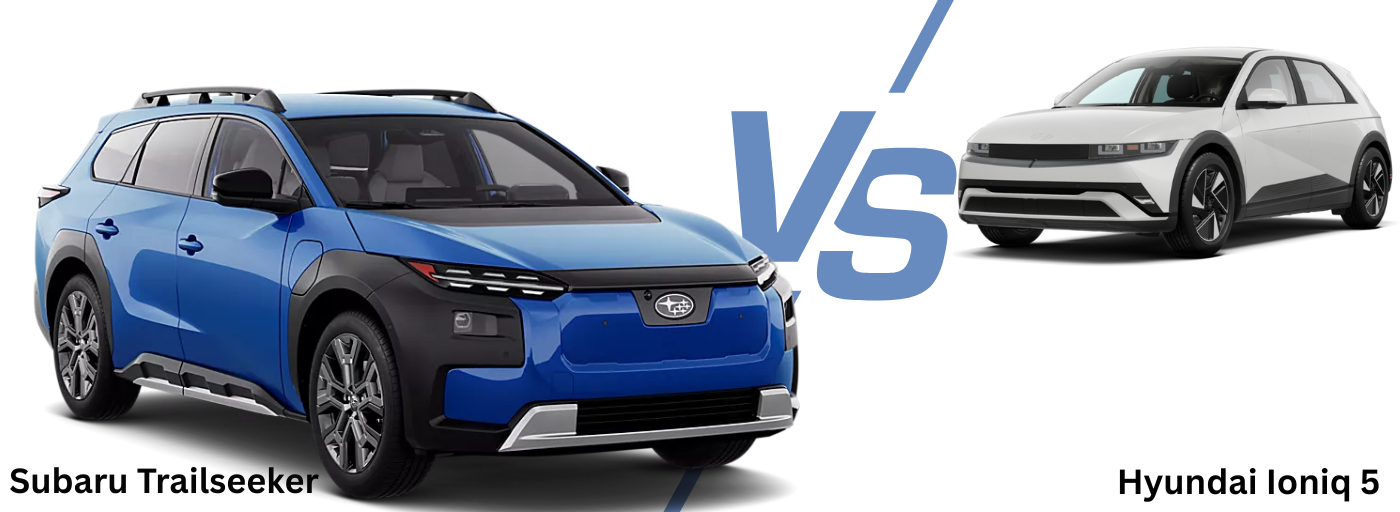
Trailseeker vs. Hyundai IONIQ 5
As a smaller crossover, the IONIQ 5 has set the standard for Hyundai with its e-GMP platform. The hatchback/crossover is available with a single- or dual-motor driveline, two battery sizes, and five trim levels.
- If you get the IONIQ 5 SE Standard Range model, you only get a 63-kilowatt-hour battery with 245 miles of range. The Trailseeker comes standard with a 74.7-kilowatt-hour battery and a range starting at 281 miles.
- The dual-motor Trailseeker is rated at 375 horsepower. Much more than the IONIQ 5 dual-motor model at 320 horsepower
- Many people like the IONIQ 5’s advanced and futuristic design. However, it is not for everyone. That is why Trailseeker has a more handsome design that is much easier on the eyes.
- The Trailseeker offers more cargo space than the IONIQ 5 with the rear seats down. You can load the Subaru with up to 74.0 cubic feet of stuff. The Hyundai offers up to 58.5 cubic feet of cargo space.
- Subaru has always offered higher ground clearance across all its models with Symmetrical All-Wheel Drive to allow them to travel farther from the highway. The Trailseeker stands 8.5 inches above the ground, while the IONIQ 5 XRT with all-wheel drive has only 7 inches of ground clearance.
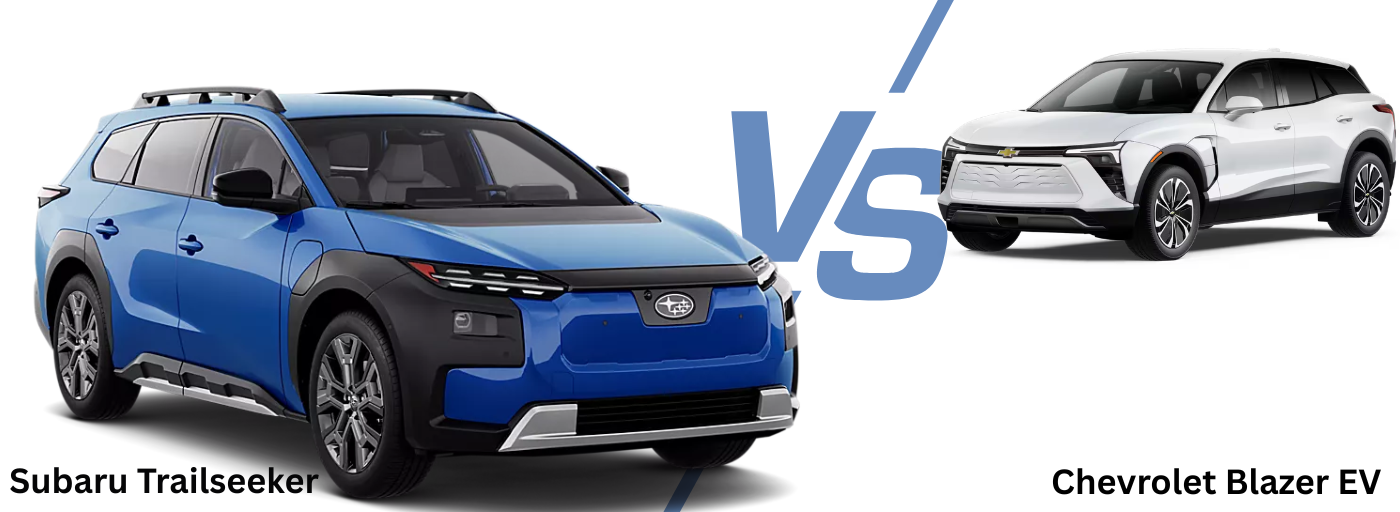
Trailseeker vs. Chevrolet Blazer EV
As part of General Motors’ push to expand its electric vehicle lineup, the Blazer EV offers signature design, innovative features, and a high level of technology. Available in both single- and dual-motor all-wheel-drive models, it is offered in three trim levels.
- The dual-motor Trailseeker is rated at 375 horsepower. Much more than the Blazer EV LT dual-motor model at 300 horsepower
- Subaru has always offered higher ground clearance across all its models with Symmetrical All-Wheel Drive to allow them to travel farther from the highway. The Trailseeker stands 8.5 inches above the ground, while the Blazer EV with all-wheel drive has only 8.0 inches of ground clearance.
- The standard Symmetrical All-Wheel Drive system on the Trailseeker is a full-time system. It also includes X-Mode with Downhill Assist Control. The Blazer EV’s all-wheel-drive system is not only an option but also an on-demand system.
- The Trailseeker offers more cargo space than the Blazer EV with the rear seats down. You can load the Subaru with up to 74.0 cubic feet of everything. The Chevrolet offers up to 59.1 cubic feet of cargo space.
- The Trailseeker is one of the better values among all-wheel-drive EV SUVs. Based on comparable base models, the price difference between it and the lowest-priced Blazer EV with dual-motor all-wheel drive is around $10,000.
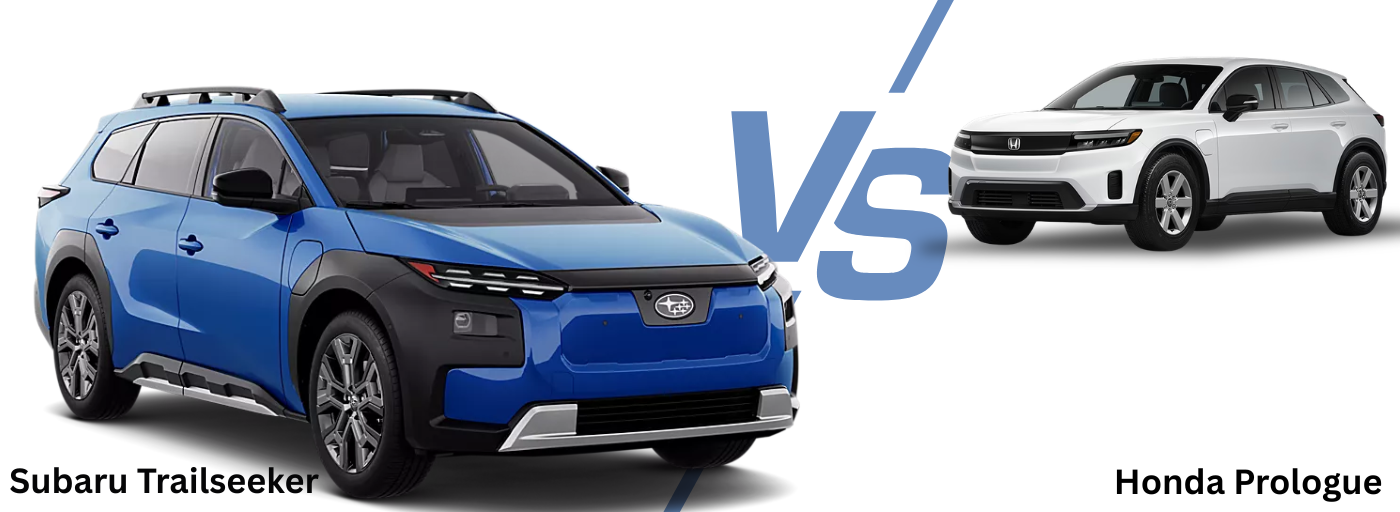
Trailseeker vs. Honda Prologue
Honda offers a value-oriented electric SUV that fits well with many families. Available in both single- and dual-motor all-wheel drive models, there are three trim levels to choose from.
- The dual-motor Trailseeker is rated at 375 horsepower. Much more than the Prologue EX dual-motor model at 300 horsepower
- Subaru has always offered higher ground clearance across all its models with Symmetrical All-Wheel Drive to allow them to travel farther from the highway. The Trailseeker stands 8.5 inches off the ground, while the Prologue EX with all-wheel drive has only 8.1 inches of ground clearance.
- The standard Symmetrical All-Wheel Drive system on the Trailseeker is a full-time system. It also includes X-Mode with Downhill Assist Control. The Prologue’s all-wheel-drive system is not only an option but also an on-demand system.
- The Trailseeker offers more cargo space than the Prologue with the rear seats down. You can load the Subaru with up to 74.0 cubic feet of everything. The Chevrolet offers up to 57.7 cubic feet of cargo space.
- The Trailseeker is one of the better values among all-wheel-drive EV SUVs. Based on comparable base models, the price difference between it and the lowest-priced Prologue with dual-motor all-wheel drive is around $3,000.
Compare 2026 Subaru Trailseeker to the Competition
 This page is best experienced in Landscape Mode.
| EV Crossovers | Subaru Trailseeker | Ford Mustang Mach-E | Hyundai IONIQ 5 | Chevrolet Blazer EV | Honda Prologue |
|---|---|---|---|---|---|
| Trims | 4 | 4 | 5 | 3 | 3 |
| Colors | 7 | 8 | 11 | 6 | 7 |
| Battery Size | 74.7 kWh | Std Range RWD/AWD-73 kWh
Extended Range AWD-88 kWh |
SR-63 kWh
ER-84 kWh |
FWD, AWD-85 kWh
RWD, SS-102 kWh |
FWD, AWD-85 kWh |
| Horsepower | 375 | SR RWD-250
SR AWD-225
ER AWD-370 |
R-168
ER 2WD-225
AWD-320 |
FWD-220
AWD-300
RWD-365
SS-615 |
FWD-220
AWD-300 |
| Torque | N/A | SR RWD-387
SR AWD-500
ER-AWD-500 |
RWD-258
AWD-446 |
FWD-243
AWD-355
RWD-325
SS-650 |
FWD-243
AWD-355 |
| DriveTrain | AWD | RWD
AWD |
FWD
AWD |
FWD
RWD
AWD |
FWD
AWD |
| Battery Type | Lithium-ion | Lithium-ion | Lithium-ion | Lithium-ion | Lithium-ion |
| Range | Premium-281
Other Trims-274 |
SR RWD-260
SR AWD-240
ER AWD-300 |
SR-245
ER RWD-318
ER AWD-289 |
FWD-312
AWD-283
RWD-334
SS-303 |
FWD-296
AWD-281 |
| Infotainment | 14" | 15.5" | 12.3" | 17.7" | 11.5" |
| Front Headroom | 38.8" | 38.9" | 39.8" | W/O Sunroof-40.9"
W/ Sunroof-39.4" |
39.6"
W/ Sunroof-38.2" |
| Front Legroom | 42.1" | 43.3" | 41.7" | 44.2" | 41.4" |
| Rear Headroom | 38" | 38.2" | 38.7" | W/O Sunroof-38.1"
W/ Sunroof-36.7" |
38.1"
W/ Sunroof-36.7" |
| Rear Legroom | 35.3" | 38.1" | 39.4" | 38.9" | 39.4" |
| Base Price | $39,995 | $37,795 | $35,000 | $44,700 | $39,900 |