Comparing the 2026 Subaru BRZ to the Competition
The BRZ is a lightweight front-engine, rear-drive sports car and the first model Subaru developed in cooperation with Toyota. They did this to share development costs for a model with a dedicated platform, producing what is clearly a low-volume vehicle. Not everyone can fit a sports car into their life, but those who do are happy they can. BRZ stands for Boxer engine, Rear wheel drive, and Zenith, the latter meaning the highest point and thus the peak of design and performance for its mission. Before the BRZ and its Toyota counterpart arrived for the 2013 model year, the Mazda MX-5 had essentially had this category to itself for over two decades.
The whole idea of the BRZ is to distill a vehicle to the core of what makes driving enjoyable. It performs well, but performance is not the primary goal; driving engagement and enjoyment are the highest priority. That is why it avoids the complexity of turbocharging or even Subaru’s beloved all-wheel drive to deliver a pure sports-car experience. Under the hood is a Subaru-designed 2.4-liter horizontally opposed 4-cylinder engine producing 228 horsepower and 184 lb-ft of torque. The flat engine configuration lowers the overall center of gravity. The engine is paired with either a 6-speed manual or a 6-speed automatic. The front suspension features struts, while the rear uses a double-wishbone design.
It doesn’t appear to be much different from the original, but the BRZ is in its second generation, launched in 2022. Along with some styling details, the biggest changes included a larger engine for more torque and a body with 50% more torsional rigidity.
Enjoyment, like all emotions, is difficult to quantify, making this comparison a little different from comparing crossovers, where figures of rear seat room, cargo space, and towing capacity can be key differentiators. Nobody buys a BRZ or its competitors for their cargo space, but you do want enough to suit your basic needs. Nonetheless, this comparison will provide some basic quantitative differences between the BRZ and its direct or near competitors.
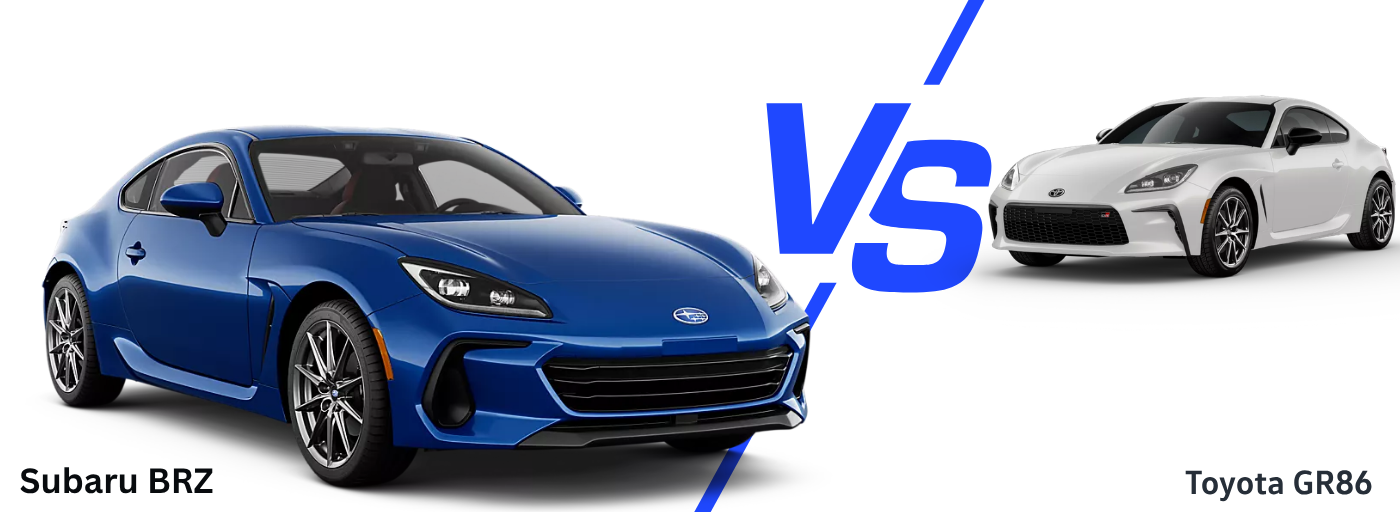
BRZ vs. Toyota GR86
As mentioned, the BRZ and GR86 were developed together. Both use the same Subaru engine and transmissions. While each has its own face, the body and interior are generally identical, with minor variations in details. Like the BRZ, the GR86 name needs some decoding, with “GR” standing for Gazoo Racing, Toyota’s in-house racing team, while 86 is a homage to the 1983-87 Corolla 2-door model, which was Toyota’s last lightweight front-engine rear-drive coupe. Most of the differences are subtle and come down to personal taste.
- The BRZ has a higher entry cost reflecting more standard features, such as a configurable digital instrument cluster, available Ultrasuede and leather seats, and available heated front seats.
- The two models differ in final suspension tuning. Engineered for grip and balanced cornering. The BRZ features stiffer front springs, softer rear springs, and different steering knuckles to help keep the car firmly planted and predictable when pushing the limits, while the GR86 is a little more prone to swinging out its tail in curves.
- The GR86 has a more aggressive throttle, whereas the BRZ’s throttle is more linear and gradual, allowing for smoother modulation.
- The GR86 (in certain trims) features a duckbill spoiler, while the BRZ usually showcases a more elegantly sculpted trunk lid.
- Within the essentially identical cabins, you will find red stitching and carpet accents in the GR86, while the Subaru features blue or silver stitching with black carpets.
- Subaru provides 3 years of free roadside assistance for the BRZ compared to two years for the GR86.
- The BRZ seats feature whiplash protection by applying rearward force to the body, which creates a forward force on the head restraint. The GR86 seats lack this feature.
- The convenience and safety of Blind Sport Alert and Rear Cross Traffic Alert are standard on the BRZ but are only on the top GR86 trim level.
- The BRZ’s standard gas-charged dampers provide better control over rough surfaces. The GR86 does not offer gas-charged dampers.
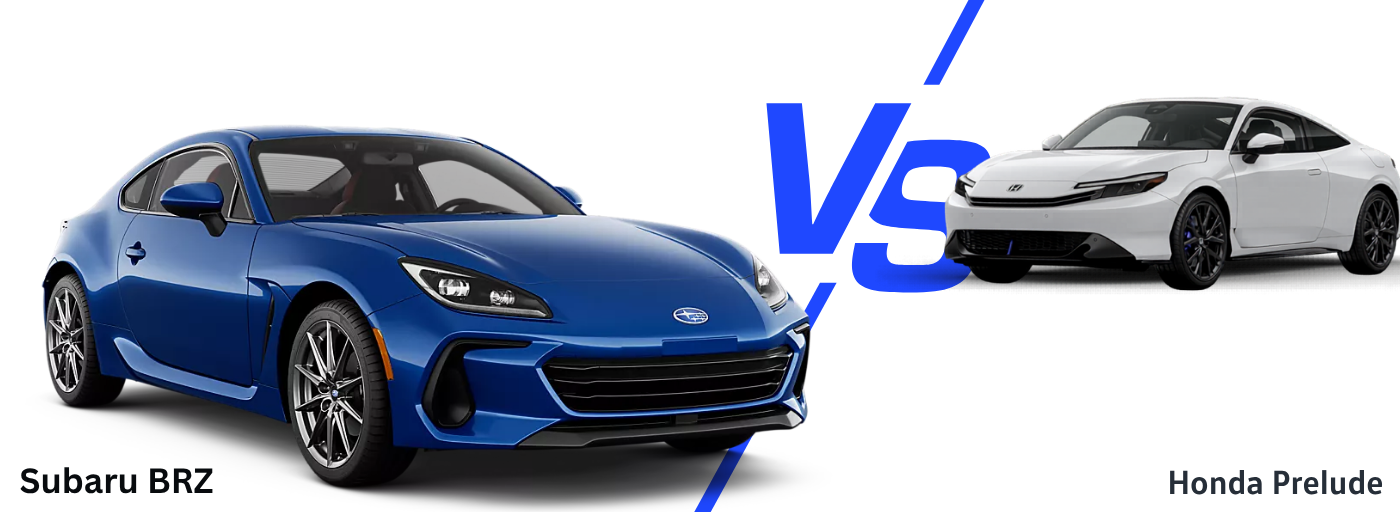
BRZ vs. Honda Prelude
The Prelude was one of several front-wheel-drive coupes that were popular in the late 70s and 80s. There were five generations of Preludes before it was discontinued, along with nearly all of its competitors, in the early 2000s, as people switched to more practical SUVs as their alternatives to sedans.
Honda brought back the Prelude for the 2086 model year. Like its predecessors, it is a front-wheel-drive compact coupe, though it is based on the Civic Platform rather than the Accord as before. It also uses the Civic Hybrid drivetrain, producing 200 horsepower and 232 lb-ft of torque. Like other Honda hybrids, it has no transmission: the electric motor powers the wheels up to highway speeds while the engine acts as a generator. It does have an S+ Shift system that simulates gear changes, which has received mixed reviews from testers. Overall, the Prelude is sporty rather than a sports car, with front-wheel drive, concessions to both fuel efficiency and practicality via its rear hatch, and a break from all previous Preludes.
- The Prelude offers the same practical advantages over the BRZ that many cars do, such as more interior space, a rear seat you can put people in, more cargo space, and better fuel mileage, but that is because it is not a sports car, by virtue of:
- It is not rear-wheel drive – the driver doesn’t balance forward motion strictly through the rear wheels, with the front wheels solely devoted to steering
- No manual transmission – driver doesn’t have full control over the engine’s varying rpm characteristics
- Lightweight – the Prelude weighs about 400 pounds more than the BRZ.
- The Prelude starts at over $6,000 over the BRZ’s Starting price ($35,860 vs $42,000)
- The BRZ features both front and rear vented discs to help dissipate heat in hard braking. The Prelude does not have rear ventilated brakes.
- The BRZ’s standard gas-charged dampers provide better control over rough surfaces. The Prelude does not offer gas-charged dampers.
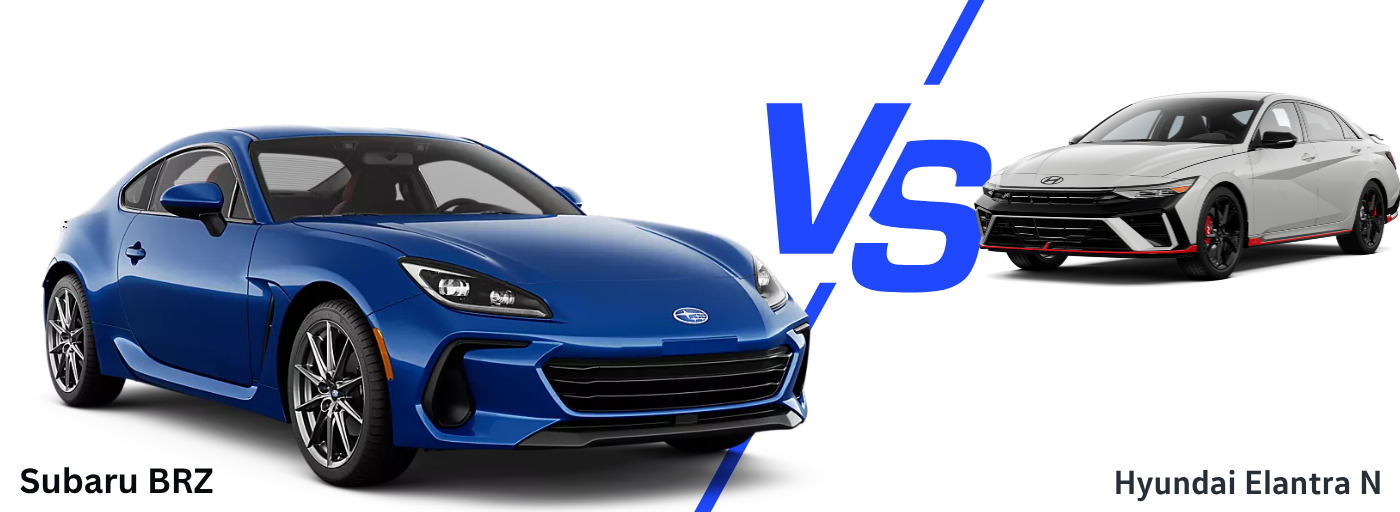
BRZ vs. Hyundai Elantra N
The Elantra N, a high-performance version of the Elantra, functions more as a compact sport sedan than a traditional sports car. It features a turbocharged 2.0-liter inline-4 engine that delivers 286 horsepower and 289 lb-ft of torque, paired with an 8-speed dual-clutch automatic transmission. A variant with 276 horsepower (and the same torque) uses a 6-speed manual transmission. In both configurations, power is directed to the front wheels. Clearly, the Elantra N is much quicker than the BRZ, but power does not a sports car make.
- Like the Prelude, the Elantra N has several practical advantages over the BRZ, especially with a second set of doors, but even with the 6-speed manual, it delivers the same sports-car experience.
- The Elantra N is significantly less affordable, with a starting price of $40,495, compared with $35,860 for the BRZ.
- While the Elantra N is more powerful, its turbocharged engine lacks the direct, linear throttle response of the normally aspirated BRZ engine.
- The BRZ is better balanced in the curves, with a front/rear weight distribution of 53/47, compared with 63/37 for the Elantra N.
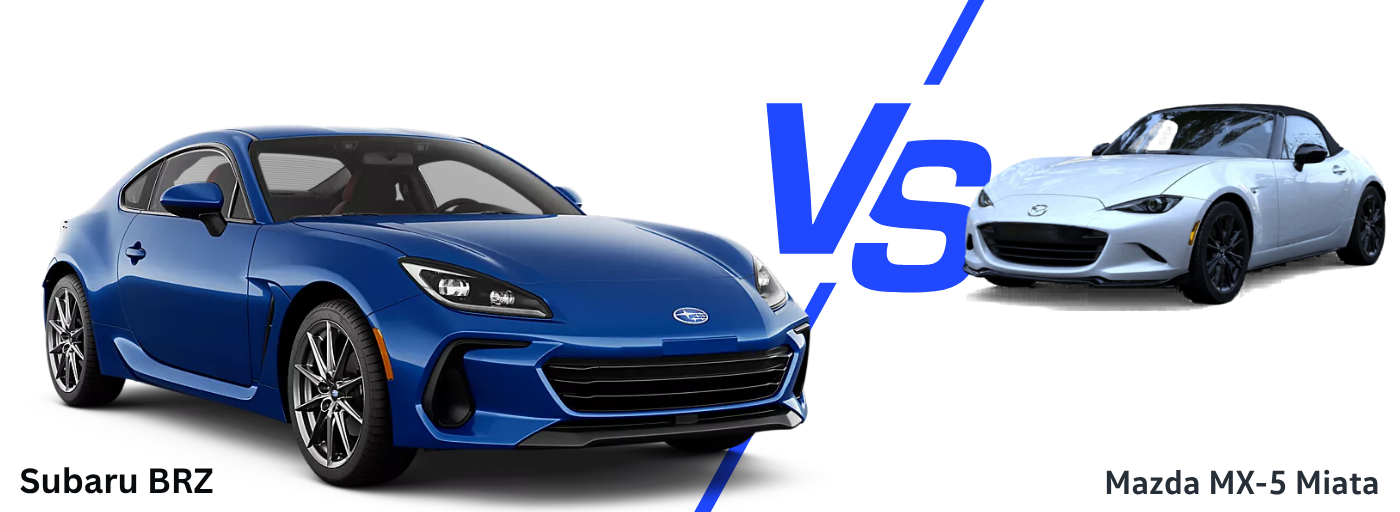
BRZ vs. Mazda Miata MX-5
There can be little doubt that the BRZ owes much to the Miata MX-5 for resurrecting the lightweight sports car concept from the wreckage of fun but unreliable, aging British models that inspired both. The Miata has been around since the 1990 model year, and while it has become heavier and more powerful across its four generations, it has remained true to its lightweight sports car concept. The MX-5 Miata is powered by a 2.0-liter inline-4 engine that produces 181 horsepower and 151 lb-ft of torque. Once purely a soft-top roadster, the Miata RF features a power-removable roof that keeps the rear pillars and window in place. The more coupe-like RF model is the more direct competitor to the BRZ.
- The BRZ has 47 more horsepower than the MX-5 (228 vs. 191).
- The BRZ also greatly exceeds the MX-5 in torque (184 vs. 151 lb-ft), with torque peaking at 3700 rpm, compared with 4000 for the MX-5.
- The BRZ is a little easier to live with. While the rear seats are impractical for most people, they do provide convenient space for carry-on items such as a briefcase, daypack, or even an umbrella. The Miata has nothing but a wall behind the seats.
- The BRZ can also carry almost 40% more in its trunk compared to the MX-5 RF (6.26 vs. 4.48 cubic feet).
- The BRZ promises a smoother highway ride with a wheelbase of 101.4 inches vs. 90.9 inches for the MX-5.
- The BRZ is equipped with a driver’s knee airbag, which is not available on the MX-5.
- The BRZ seats feature whiplash protection by allowing rearward body force to generate a forward force on the head restraint. The MX-5 has no such feature.
- The BRZ’s standard “hill holder” keeps it from rolling backward when engaging first gear on a steep incline. The MX-5 has no such feature.
Compare 2026 Subaru BRZ to the Competition
 This page is best experienced in Landscape Mode.
| Two Door Sports Car | Subaru BRZ | Toyota GR86 | Honda Prelude | Hyundai Elantra N | Mazda MX-5 Miata |
|---|---|---|---|---|---|
| Trims | 2 | 3 | 2 | 2 | 3 |
| Colors | 8 | 6 | 5 | 6 | 6 |
| Engine | 2.4 L H-4 | 2.4L H-4 | 2.0L I-4 Hybrid | 2.0L Turbo I-4 | 2.0 L inline-4 |
| Horsepower | 228 @ 7000 | 228 @ 7000 | 200 |
Auto: 286 @ 6000
Manual: 276 @ 5500 |
lop0 |
| Torque | 184 @ 3700 | 184 @ 3700 | 232 @ 0-2000 | 289 @ 2100 | 151 @ 4000 |
| Transmission |
6-Spd Manual
6-speed Auto |
6-Spd Manual
6-speed Auto |
N/A |
6-Spd Manual
8-speed dual-clutch Auto |
6-Spd Manual
6-speed Auto |
| DriveTrain | RWD | RWD | FWD | FWD | RWD |
| Fuel Economy (Hwy/City/Comb) |
Auto: 21 / 30 / 25
Manual: 20 / 27 / 22 |
20 / 26 / 22 | 46 / 41 / 44 |
Auto: 20 / 27 / 23
Manual: 21 / 29 / 24 |
Auto: 26 / 35 / 29
Manual: 26 / 34 / 29 |
| Infotainment | 8" | 8" | 9" | 10.25" | 8.8" |
| Front Headroom | 37" | 37" | 37.2" | 40.6" | 36.9" |
| Front Legroom | 41.5" | 41.5" | 42.3" | 42.3" | 43.1" |
| Rear Headroom | 33.5" | 33.5" | 33.1" | 37.3" | |
| Rear Legroom | 29.9" | 29.9" | 32" | 38" | |
| Cargo Space Behind 2nd Row (cu.ft) | 6.26 | 6.26 | 15.1 | 14.2 | 4.48 |
| Base Price | $35,800 | $31,400 | $42,000 | $35,100 |